You can usually tell how a driveway was built by how it behaves after a couple seasons. One side stays tight and flat, the other side gets a hairline crack that turns into a little step. The front corner by the street pops off when a delivery truck turns in. Or the panel right outside the garage starts sounding hollow when you walk it, then you see the slab has bridged over a soft spot.
Around Albuquerque, NM we see all of that because the ground is not uniform. One house is sitting on sandy fill. The neighbor hits caliche a foot down. Then you get a winter week where nights drop below freezing, the soil tightens up, and a warm afternoon thaws the top back out. Rebar and thickness are part of the answer, but they are not the whole answer. The slab, the steel, the base, and the joints all have to match what you drive and what you’re building over.
Slab thickness starts with load, not with the finish you pick
For a standard passenger-car driveway, a lot of the performance comes from having enough concrete mass to spread the load into the base without flexing. A common target is a 4 inch slab, measured after finishing, not “about 4” before it gets worked and edged. If we know the driveway is going to see heavier point loads, we bump thickness where it matters, because a thicker slab reduces bending and keeps cracks tighter.
Heavier loads are not just “big vehicles.” They are concentrated loads. A dual rear wheel truck, a trailer jack, a forklift on a jobsite visit, they put a lot of force into a small footprint. That is where a 5 inch or 6 inch slab makes sense, especially at the apron and the first parking bay outside the garage.
Thickness also matters at transitions. The street connection, the garage approach, and any spot that crosses a utility trench are common weak points. We plan thickness and base so those spots do not become hinges.
Rebar, welded wire, or fiber, what each one actually does in a driveway
Steel does not stop concrete from cracking. Concrete shrinks as it cures. It cracks where it is weakest. Reinforcement is there to hold the slab together when it does crack, so you do not get vertical movement and broken edges.
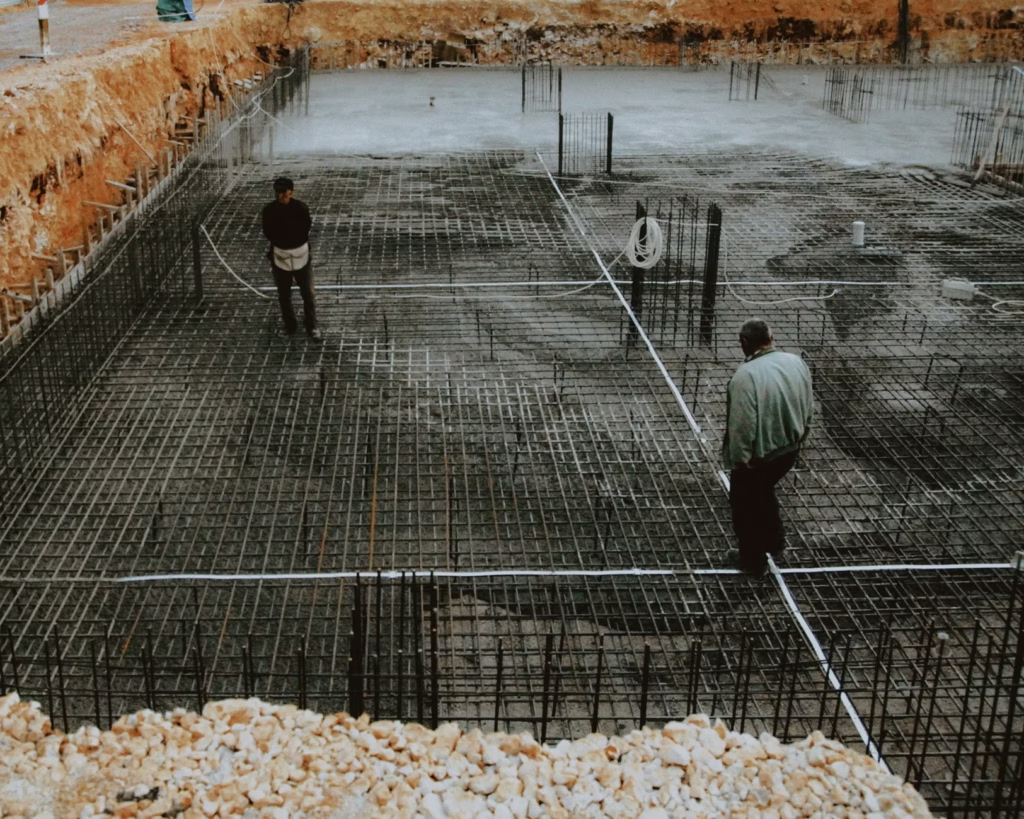
Rebar is the most predictable option when it is installed right. In driveways we typically use a grid pattern and keep it up in the slab, not lying on the dirt. If the steel ends up at the bottom, it is not doing much. Chairs, dobies, or a lift during the pour are what keep it in the right zone.
Welded wire fabric can work, but it has to be flat and supported. The failure mode we see is wire rolled out on grade, then the concrete gets placed on top and the wire never gets pulled up. Now it is basically decoration.
Synthetic fiber helps with plastic shrinkage cracking in the first few hours, especially in dry wind. It is not a replacement for steel if you need load transfer and crack control under heavy vehicles.
Base compaction is where sandy soils and caliche pockets make or break the slab
If the base moves, the slab follows. In Albuquerque we run into both loose, sandy material and hard caliche lenses on the same driveway. That mix is tricky. The sand compacts, then later it can wash or pump. The caliche barely moves, until it fractures or you have a pocket next to it that settles.
We treat the base like a structural layer. That means removing soft material, bringing in a graded aggregate base, and compacting in lifts. A typical lift is 3 to 4 inches at a time so the compactor can actually do its job. You cannot compact 10 inches of loose base from the top and call it good.
Moisture matters. Base compacts best at near-optimum moisture, not bone dry and not muddy. If you see base powdering under a plate compactor, it is too dry. If it is pumping, it is too wet.
Where caliche shows up, we either cut it out to a uniform depth or we build a consistent section over it, so the slab is not half on rock and half on sponge.
Freeze-thaw swings change how we handle thickness, steel placement, and curing
Freeze-thaw in this area is not like a deep-freeze climate, but we still get nights below 32°F and sunny days that warm the slab. That cycling can work water into joints and cracks. If the slab is thin and the base is uneven, those cycles show up as rocking panels and spalled edges.
Steel placement matters more in this situation because it keeps cracks tight. Tight cracks shed water better than open cracks. We also pay attention to cover. Rebar needs enough concrete over it so it is not too close to the surface, where moisture and deicers can reach it.
Curing is a big piece homeowners do not see. A driveway that dries too fast can get surface checking and weak paste at the top. In spring wind, concrete can lose moisture in hours. We use curing methods that fit the job, like curing compound or wet curing, and we protect fresh concrete if temperatures are headed toward freezing the first night.
A good rule on use is simple. Keep cars off it for several days, and keep heavy vehicles off longer. Concrete gains strength over weeks, not overnight.
RVs and work trucks need thicker sections and stronger edges, not just “more rebar”
If you park an RV, a work truck with a loaded bed, or you back a trailer up to the side yard, we design for that load path. It is not enough to throw extra steel in the middle and hope for the best.
We look at where the tires sit day after day. Repeated loading in the same tracks is what creates fatigue cracking and settlement if the base is not right. For those driveways we commonly thicken the slab in the parking lanes and at the apron, and we pay attention to edge detail so the slab does not break off when a heavy tire rides near the edge.
Details that matter for heavy parking
- Thickened edge or turned-down edge where the slab is exposed.
- Dowel bars at cold joints if the pour is staged.
- A stable base that is compacted in lifts, not just “rolled once.”
If you want an RV pad tied into a driveway, we also plan the joint between the two pours. That joint is where differential movement likes to show up first.
Control joints and dowels decide where cracks go and whether panels stay level
Rebar is not a substitute for joints. Joints are how we tell concrete where to crack. The basic rule is to cut control joints at a spacing that matches slab thickness and panel geometry, and to cut them early enough that the concrete does not crack on its own first.
A common target is joints spaced so panels are close to square, and we avoid long skinny rectangles that like to crack diagonally. Joint depth matters too. For a 4 inch slab, a saw cut is typically about 1 inch deep. Too shallow and it will not work.
Load transfer across joints is the next step. If you want panels to stay level under wheel loads, dowels help. We use smooth dowels in sleeves or with bond-break so the slab can shrink without locking up. If you tie panels together wrong, you can create random cracking because the slab cannot move.
We also plan isolation joints where the driveway meets the garage slab, stem walls, or columns. That keeps the driveway from pushing on the house during expansion.
What we look at on your property before we spec thickness and reinforcement
We do not guess from the street. We look at the grade, drainage, and what the existing slab is telling us, if there is one. Water is a big driver. Downspouts that dump next to the driveway, a negative slope toward the garage, or a low spot that holds water after a storm, those are the setups that lead to base erosion and settlement.
We also pay attention to soil changes across the footprint. In Albuquerque, NM it is normal to see a driveway that crosses fill near the sidewalk and hits native material closer to the house. If we suspect that, we plan base excavation and replacement to get a uniform platform.
If this is a Concrete Driveway Replacement, we look at the old failure mode. Was it random cracking, corner breaks, settlement at one panel, or surface scaling? Each one points to a different fix. If it is a Concrete Driveway Repair situation, we check whether the slab is still supported. A crack you can live with is one thing. A crack with vertical displacement is a different animal.
For Concrete Driveway Installation, the best driveway is the one that matches how you use it. Cars, RV, work truck, trailer, we build for the real load.
Key Takeaways
- A 4 inch slab fits many car-only driveways, but heavy parking often calls for thicker sections in the wheel paths and apron.
- Rebar holds cracked concrete together, it does not prevent cracking, placement in the slab matters as much as the size.
- Base compaction in 3 to 4 inch lifts is what keeps sandy spots and caliche pockets from turning into settled panels.
- Freeze-thaw cycles make tight cracks and good curing important, they reduce spalling and surface checking. (See protecting your new concrete driveway.)
- Control joints need the right spacing and depth, and dowels help keep adjacent panels from stepping under wheel loads.
Conclusion
Rebar and a thicker slab are good tools, but they only work if the base is uniform and the joints are planned. That is the part we push on, because the ground is what decides whether your driveway stays flat. If you are parking an RV or a work truck, tell us up front. We will thicken the right zones, detail the edges, and build a base that can take repeated loading without pumping out.
If you want us to look at your driveway plan or an existing slab that is starting to move, we can walk it with you, check drainage and soil conditions, and write a spec that fits your property and how you actually use it. If you want more background reading first, start with concrete driveway construction deciding on thickness and reinforcement, then concrete driveway longevity, and if you are timing a pour, best time of year to pour a concrete driveway in Albuquerque. If you are dealing with the city side of it, read navigating permits for Albuquerque concrete driveways. You can also browse the rest of our blogs or reach us through our contact page.
External references that back up the nuts and bolts in this article: ACI (American Concrete Institute) publishes the standards we lean on for mix design and flatwork details, the Portland Cement Association has solid plain-English guides on cement and curing, the National Ready Mixed Concrete Association covers ready-mix production and testing, and the NOAA National Weather Service is where we check local freeze nights, wind, and rain timing before a pour.
References
- American Concrete Institute (ACI): https://www.concrete.org
- Portland Cement Association (PCA): https://www.cement.org
- National Ready Mixed Concrete Association (NRMCA): https://www.nrmca.org
- NOAA National Weather Service: https://www.weather.gov