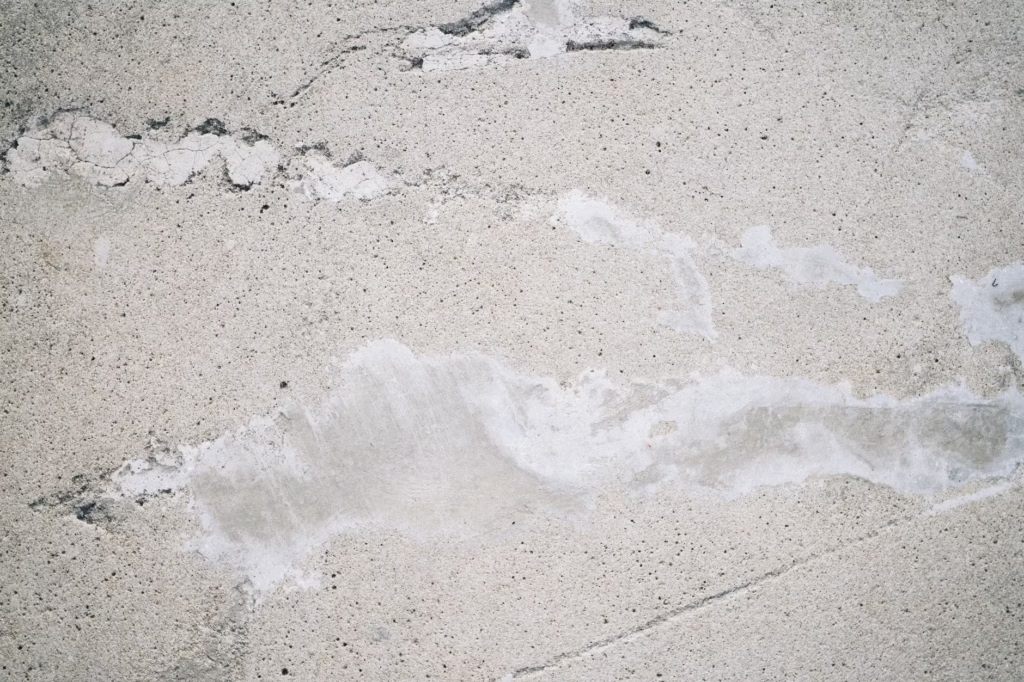
You wash the truck on a Saturday, the concrete looks fine while it’s wet, then it dries and you see it. Little pale chips along the tire paths. A rough patch by the garage where the sun hits hardest. Sometimes it starts at the edge of a control joint, sometimes it’s right in the middle where you walk every day. By the second year those chips can turn into a scabby surface that holds dirt and shows every footprint.
Around Albuquerque, NM, we see that pattern after a stretch of hot, windy days, then a cold night that dips below 32°F. The top 1/16 to 1/8 inch of the slab is the first thing that fails. Not the whole driveway. Just the skin.
Flaking is preventable. It comes down to what’s in the mix, how we finish it, how we cure it, and how you treat it through the first winter (more on timing here: best time of year to pour a concrete driveway in Albuquerque).
Flaking starts at the surface, the top 1/8 inch is the weak link
Most driveway “flakes” are surface scaling. The concrete below is still sound, but the paste at the top lets go. We usually see it in the first 6 to 24 months if something went wrong during placement or curing. If it waits 8 years to show up, that’s a different conversation.
Here’s what’s happening. Concrete bleeds water to the surface as it sets. If the surface gets finished while that bleed water is still there, the top layer ends up with a higher water to cement ratio than the rest of the slab. That thin layer dries out fast in our sun and wind, and it’s porous. Add a few freeze nights and you get small pop-outs and flaking.
We also look for finishing burn. A steel trowel can densify the very top, then the slab can’t “breathe” evenly. That can trap moisture just under the surface, and the next freeze cycle can shear that skin off. The failure mode looks like thin potato chips of concrete.
Mix design choices that hold up in sun, wind, and freeze nights
Durable surface starts before the truck shows up. We order a driveway mix that’s built for exterior flatwork, not a “one mix fits all” load. The basics matter.
We keep the water content under control. If we need workability, we ask for a water reducer, not a driver adding water at the curb. A common target for exterior durability is a water to cement ratio at or below about 0.50. You can’t eyeball that after the fact, you have to manage it from the start.
We also pay attention to entrained air for freeze resistance. Even in a mostly dry climate, a night at 28°F after a damp day can do damage. Proper air entrainment gives microscopic voids so expanding ice has somewhere to go. Too little air, and the surface scales. Too much air, and the surface can get weak. That’s why we don’t “guess” with site-added admixtures.
For surface toughness, we’ll specify an appropriate cement content and aggregate gradation, and we avoid mixes that are overly sandy. Sand-rich mixes finish pretty, then wear fast.
Finishing timing, we wait for the bleed water, then we finish once
A lot of flaking is made with a trowel. The timing is everything.
On a hot, dry, windy day, the surface can look ready while the slab is still bleeding underneath. If you close it up early, you trap that water. Later it evaporates and leaves a weak, dusty layer. Then tires and foot traffic start peeling it.
We watch the surface, not the clock. We wait until the bleed water has evaporated and the sheen is gone. That might be 30 minutes on a warm day, or it might be a couple hours if the air is cool and still. If the wind is pulling moisture off too fast, we use an evaporation reducer (a light spray) so the surface doesn’t crust while the concrete underneath is still plastic.
For a driveway, we usually finish with a broom texture (details here: choosing the perfect concrete driveway finish for your Albuquerque home). It gives grip and it’s forgiving. Hard steel trowel finishes belong on interior slabs, not outside where a slick surface also becomes a safety problem when it’s wet. We edge and joint cleanly, then we leave it alone.
Curing is not optional, we keep it damp and protected for 7 days
Curing is where Albuquerque driveways turn out right or start failing. Concrete does not “dry” to get strong, it hydrates. If the surface dries out too early, hydration stops near the top, and that’s the exact layer that later flakes.
We aim for a 7-day cure on exterior flatwork. That can be done a few ways, and we pick the method based on conditions and access.
- Curing compound: A spray-on cure meeting ASTM C309 is common. Applied evenly right after finishing, it locks moisture in. The key is coverage. Missed stripes become weak stripes.
- Wet cure: Keeping the slab damp with soaker hoses and burlap works well if the homeowner can keep up with it. It’s effective, but it takes discipline for a full week.
- Curing blankets: On cold nights, insulated blankets help prevent the surface from dropping too fast.
Wind is the enemy. A 20 mph spring wind can pull moisture out of the surface in minutes. That’s why we plan curing before we place a yard of concrete. Once it’s on the ground, you’re committed.
First-winter care, deicers and snow shovels can wreck a new slab
A driveway can be poured perfectly and still get chewed up in its first winter if it’s treated like an old slab (we lay this out in plain language here: protecting your new concrete driveway).
We tell homeowners to keep deicing salts off new concrete for the first winter, and longer is better. Calcium chloride and magnesium chloride work fast, and they also drive moisture into the surface. If that moisture freezes, it expands. The failure mode is scaling and pop-outs, especially in the tire tracks where meltwater sits.
If you need traction, use sand. If you have to use a deicer, use it sparingly and rinse the slab when temperatures are above freezing. Don’t let deicer slush dry on the surface.
Shovels matter too. A steel shovel edge can catch a high spot and spall the surface, especially at joints. A plastic shovel or a rubber-edged pusher is easier on new concrete.
We also like to keep vehicles off a new driveway for at least 7 days, and heavy vehicles longer. Concrete gains strength fast early on, but the surface is still young.
Sealer decisions, what we use and how we keep it from peeling
Sealer can help, but the wrong sealer, or the right sealer at the wrong time, creates its own problems.
We do not seal green concrete. A common rule is to wait at least 28 days after placement so the slab has time to hydrate and let excess moisture leave. Sealing too early traps moisture. Then you get whitening, bubbling, or a patchy look, and sometimes the surface gets soft under the film.
For driveways, we lean toward breathable, penetrating sealers where the situation calls for it. Silane or siloxane penetrators soak in and reduce water absorption without leaving a thick film that can peel under tire twist. Film-forming acrylics can look good, but they need correct prep, correct coverage, and recoat timing. If they’re laid heavy, hot tires can pick them up.
If the driveway already has light flaking, sealer is not a magic cover-up. We look at the surface first. Sometimes the right move is a light grind to remove weak paste, then a sealer. Sometimes it’s a repair. We decide based on what’s actually bonded.
Repairing flaking, we fix the cause before we patch the face
Concrete Driveway Repair is where you find out what the original slab is made of. If the surface is flaking, we probe it. A screwdriver test tells a lot. If the top keeps crumbling under light pressure, patching over it is temporary.
For small areas, we can remove loose material, clean it, and use a polymer-modified repair mortar made for thin resurfacing. The prep is the work. We want clean, solid concrete, no dust, no curing compound residue, no paint, no oil. We’ll often use a pressure washer and mechanical abrasion, then let it dry to the right condition before bonding.
If the damage is widespread, Concrete Driveway Replacement is sometimes the honest fix. Not because concrete is “bad,” but because a slab with a weak surface across the whole field keeps shedding, and you end up chasing it.
On new Concrete Driveway Installation, we build the surface to last from day one so you are not calling us back in two winters asking why it’s peeling. That’s the goal for any of our crews (and if you’re sorting out slab build, start here: concrete driveway construction deciding on thickness and reinforcement, plus do Albuquerque driveways need rebar and a thicker slab).
Key Takeaways
- Most driveway flaking is surface scaling in the top 1/16 to 1/8 inch, usually tied to finishing or curing.
- We control added water, and we use admixtures like water reducers instead of “watering it up” on site.
- We do not finish through bleed water, and we avoid steel-trowel slick finishes on exterior driveways.
- A 7-day cure (ASTM C309 cure, wet cure, or blankets) is what protects the surface in sun and wind.
- Skip deicing salts the first winter, use sand for traction, and avoid steel shovel edges on new concrete.
- Sealers help only if the slab is ready, typically after 28 days, and the product matches driveway use.
Conclusion
If your driveway is starting to flake, don’t let anyone tell you it’s “normal” and walk away. Concrete can take our weather, but the surface needs to be built and protected like it matters, because it does.
If you’re planning a Concrete Driveway Installation in Albuquerque, NM, we’ll talk through mix, finish, and curing before the pour, then we’ll give you clear do’s and don’ts for the first winter. If you’ve already got scaling, we’ll check how deep it goes and whether it’s a repairable surface issue or a slab that’s telling on itself.
Either way, we’ll keep it practical. We fix what caused it, then we fix what you can see.