You can have a driveway that looks fine the day we pull the forms, then six months later a corner settles, the approach at the garage drops, or the slab starts moving in a way no sealer is going to fix. Most of the time, it is not the concrete mix. It is what the slab is sitting on.
October is when we see it clearly. The monsoon is done, the nights start dipping into the 40s, and the ground that got soaked in August is drying back out. If your driveway has a soft spot where a tire always leaves dust, or you’ve got a low area that stays damp after a quick fall rain, that is your base and drainage talking.
Concrete driveway installation is a foundation job first. The concrete is the finish layer. If we get the excavation, compaction, base rock, and water path right, the slab behaves like it should for years.
Excavation depth is set by soil, not by “standard”
A driveway is only as stiff as the section under it. If the subgrade is loose, wet, or full of organics, a 4 inch slab will act like it is thinner. In our driveway work we set excavation depth off what we find after we strip topsoil, not off a one size number.
On a clean, undisturbed native that compacts well, we may only need enough depth to fit a proper base course and still hit finish grade at the garage and sidewalk. On disturbed fill, old driveway rubble, or spots where someone backfilled a trench, we go deeper until we are back on firm material. If we leave pockets of loose fill, the slab will bridge it at first, then the first wet season and a few vehicle loads later it drops.
A simple check we use on site is proof rolling. We run a loaded truck or roller across the exposed subgrade and watch for pumping or rutting. If we see movement more than about 1/2 inch, we do not pour on it. We rework it, dry it, or remove it.
Compaction is not “drive over it”, it is lift thickness and moisture
Compaction fails quietly. The driveway looks good, then settlement shows up at the edges, at the garage apron, or over a utility trench. The fix is not more concrete on top. The fix is doing the base correctly before the pour.
We compact in lifts. That means we spread base material in layers, usually 3 to 4 inches thick, and compact each layer before the next goes down. If you try to compact 8 inches in one go, the top gets tight and the bottom stays loose. That bottom layer is what settles later.
Moisture matters. Base rock that is bone dry will not lock up, it just vibrates. Base rock that is too wet will pump and smear. We aim for damp, not muddy. You can see it when you squeeze a handful. It should hold together, then crumble.
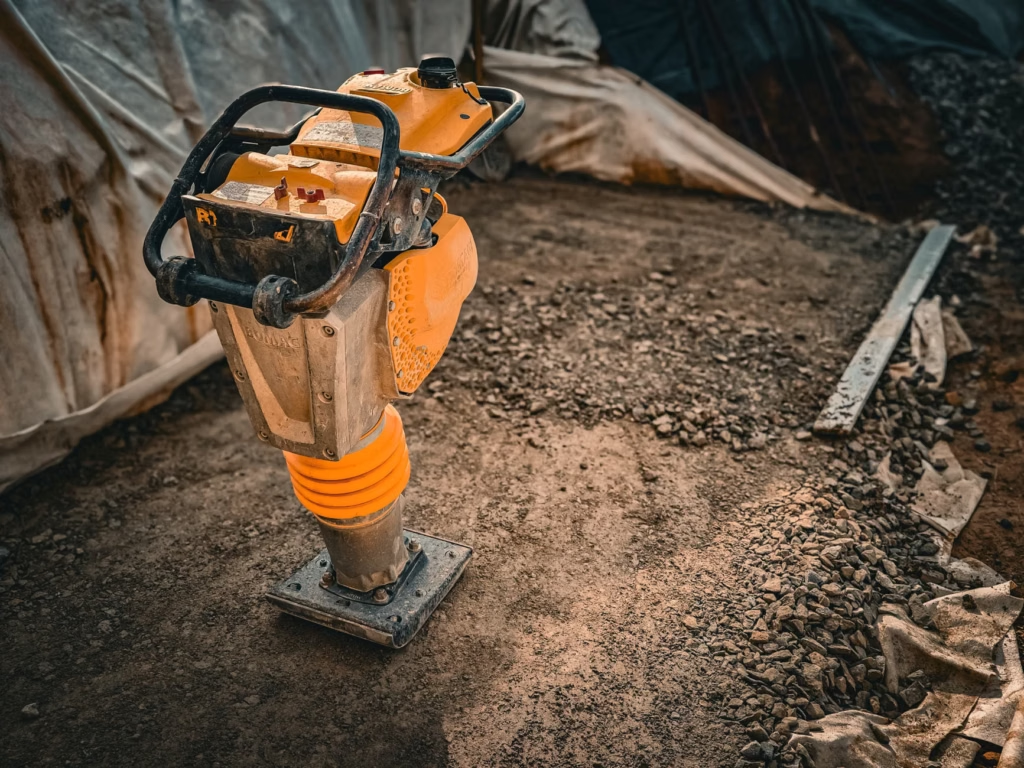
For equipment, a plate compactor works on small areas, but a driveway needs more. We use a vibratory roller where access allows, and we pay extra attention within 2 feet of forms and edges because that is where you get edge drop-off and cracking from poor support.
Base rock choice: what we use and why it behaves
Not all “gravel” is driveway base. Round river rock will never compact tight enough under a slab. It rolls. You need angular, graded aggregate that locks together.
For concrete driveway installation we typically build the base with a crushed, well graded material, something in the 3/4 inch minus family, with fines in it. Those fines are not dirt. They are crushed stone dust that fills voids and helps the base compact into a dense mat.
If we are tying into an existing driveway or a garage slab, we also look at how the base transitions. A sudden change from hard base to soft native is a hinge point. That hinge becomes a crack line. We feather the base thickness and density so the slab has uniform support.
We also keep base rock clean. If base gets mixed with clay or topsoil during grading, it turns into a sponge layer. That is when you see pumping at joints after a rain, and eventually you see settlement.
A good base is not just strong. It drains. Water has to move through and away, not sit under the slab.
Caliche and expansive soils: how we handle what’s common here
Around Albuquerque, NM, we run into caliche and clayey soils that change behavior with moisture. Caliche can be hard as concrete in one spot and crumbly in the next. Expansive clays swell when wet and shrink when they dry. That swell-shrink cycle is what lifts and drops slabs.
We do not “fight” caliche by trying to pulverize it into dust and then compact it. If it is competent and continuous, we can use it as subgrade, but we scarify the surface so the base bonds and we do not end up with a slick plane that lets the base slide.
If we hit expansive clay, we manage it two ways. First, we remove the worst of it where practical and replace with a non-expansive base. Second, we control water. Expansive soil is only a problem if it is getting wet and drying out unevenly.
We also watch for pockets. One 3 foot by 3 foot clay pocket under a tire path can cause a localized heave that looks like “mystery cracking.” The fix is not a patch. The fix is cutting out and rebuilding the support.
Drainage tie-ins: downspouts, swales, and keeping water off the slab
A driveway is a big, hard catch basin. If roof water dumps onto it, or if the yard drains across it, the best base in the world is going to get stressed. Water is the common thread in settlement, pumping, and edge erosion.
We look at the whole water path before we set forms. Downspouts are a big one. If a downspout ends at the driveway edge, it will cut a channel along the slab and wash out support. We prefer to tie downspouts into a solid drain line and daylight it away from the driveway, or route it to a swale that carries water past the slab.
Grade matters, and we set it intentionally. A driveway should shed water, not hold it. We commonly target about 1/8 inch per foot cross slope where it makes sense, and we avoid back-pitching toward the garage. If the garage floor is low, we talk through options before concrete goes in, because once it is poured the water will do what gravity tells it.
If you have irrigation near the driveway, we also flag that. A small leak can keep one edge wet for weeks.
Subgrade separation and edge support: fabric, forms, and thickened areas
One hidden failure mode is base contamination. If you place base rock directly on a soft, silty subgrade, the fines migrate. The base slowly sinks into the soil, the soil works up into the base, and your “base” turns into a muddy mix that does not drain.
Where soils call for it, we install a nonwoven geotextile separation fabric under the base. It is not a magic layer, it is a separator. It keeps the base from punching into the subgrade and keeps the base drainage working.
Edges are another weak point. The slab edge is where loads concentrate and where water gets in. We make sure the base is tight right up to the forms, and we do not leave a void at the outside edge. If an edge hangs over loose dirt, it will crack off.
At garage approaches and other high load areas, we often thicken the concrete section at the edge or at transitions. That is a simple detail that helps the slab carry loads without curling. Curling shows up as corners that lift slightly, then chip under tire traffic.
Replacement work: removing the old slab and rebuilding the support properly
Concrete driveway replacement is where shortcuts show up fast. The old slab comes out, and there is a temptation to pour right back on what is there. If the old driveway failed from base or drainage, you just reset the clock.
We remove the slab and look at what is underneath. If we find voids, soft spots, or base that has turned into fines, it all comes out. We also check for buried debris. Old brick, chunks of asphalt, and construction trash create point loads. Those point loads become cracks.
Utility trenches are common. Water, gas, sewer, irrigation, electrical. A trench backfilled with loose native will settle for a long time. If we see a trench line, we over-excavate it and rebuild it with compacted base in lifts.
For concrete driveway repair, we are straight about what is going on. If a slab section is moving because the subgrade is failing, a surface patch is not a repair. A real repair means stabilizing the support, sometimes by removing and replacing a panel, sometimes by addressing water that is feeding the problem.
By the time we pour, we want one thing: uniform, dense support under the entire slab.
Key Takeaways
- Proof rolling the exposed subgrade shows weak spots before concrete goes down, movement over about 1/2 inch means rework.
- Base rock needs to be angular and well graded, round river rock will not lock up under a slab.
- Compaction has to be done in 3 to 4 inch lifts with the right moisture, dry base and muddy base both fail.
- Caliche can be a good subgrade if it is continuous, expansive clay needs removal, rebuild, and water control.
- Downspouts and irrigation leaks wash out driveway support, tying water into drains or swales protects the base.
Conclusion
If you want a driveway that stays flat, the work happens before the first yard of concrete shows up. The excavation has to hit firm ground, the base has to compact tight in thin lifts, and the water has to have somewhere to go that is not under your slab. Fall is a good time to deal with it because you can still shape grades and get clean compaction before winter nights start freezing the surface. If you want the season-specific details, see fall concrete driveway work in Albuquerque.
If you are seeing settling, soft edges, or a driveway that never seems to dry in the same spot, we can take a look and tell you what is going on underneath. If the issue is water sitting on the slab, why water pools on Albuquerque driveways is a good place to start. If the problem is right at the house line, why Albuquerque driveways sink at the garage will sound familiar. If you are chasing heave and cracking tied to landscaping, tree roots and irrigation leaks is worth a read. From there we can lay out a plan for concrete driveway installation or concrete driveway replacement that matches your site, not a generic detail.
External references that back up the base, drainage, and subgrade points above: American Concrete Institute, Portland Cement Association, NOAA National Weather Service, USDA NRCS Soils.