
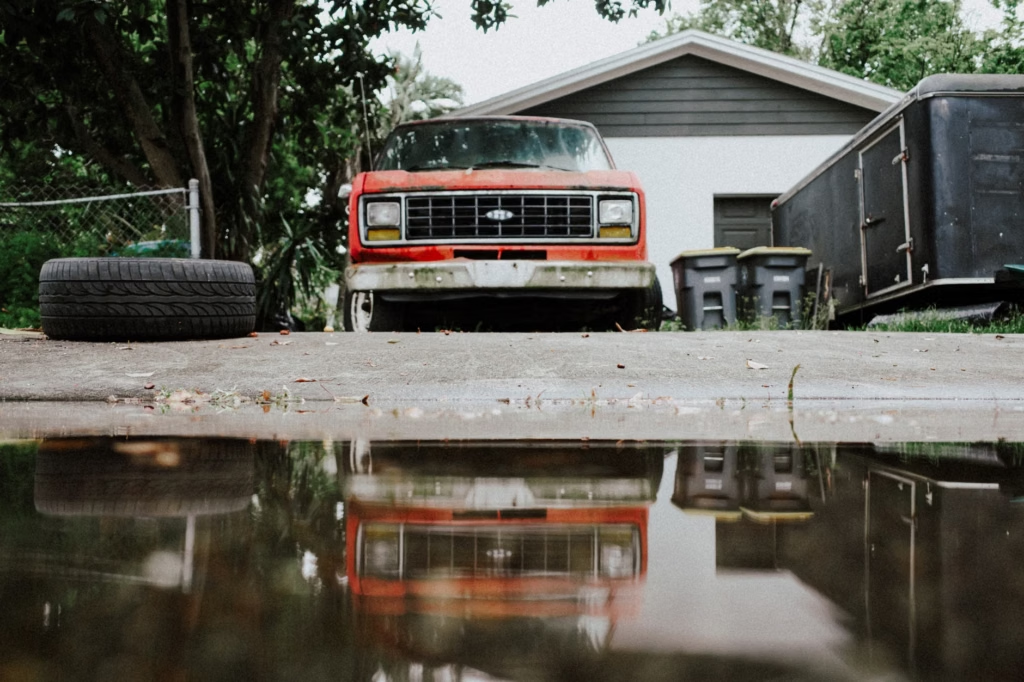
Fall storms hit hard here. You get a quick downpour, the gutter dumps, and suddenly there’s a shallow “lake” sitting right in the tire path or against the garage slab. Next morning the temperature drops into the 20s or low 30s, and that same spot is a sheet of ice. You step out with groceries and your boots slide.
Pooling water on a driveway is not just annoying. It is a sign the slab is not moving water where it needs to go. Water finds the low point, then it works the surface, carries grit, and soaks the edges. Over a few seasons you’ll start seeing dark damp lines, algae in shade, and little chips where freeze nights hit the same wet spot again and again.
A proper fix is not a bag of patch and a broom. It starts with figuring out the drainage path, then correcting slope, tie-ins, and discharge so water leaves the concrete and stays off the house.
Pooling almost always means the slope is wrong, or the slope got interrupted
A driveway does not need to look steep, but it does need consistent fall. We look for about 1/8 inch per foot minimum so water keeps moving. On a 20 foot run, that is about 2 1/2 inches of drop. If you have a dead-flat section, or a low “birdbath” in the middle, water will sit.
In Albuquerque, NM we see a lot of driveways that were placed flat to “match” the garage or the walkway, then the last finisher tried to fix it with texture. Texture does not move water. Grade does.
We check slope with a 6 foot straightedge and a level, and we also watch how water actually runs during a hose test. The common interruption points are at the sidewalk, at a decorative band, or where a patch was feathered thin.
If the slab is basically sound but has a shallow low spot, we can sometimes correct it with a bonded concrete overlay designed for exterior use, not a thin skim. If the grade is wrong across the whole panel, the right fix is removal and replacement so the slope is built into the concrete, not “added on” later.
Gutters, downspouts, and roof runoff are often the real source of the “puddle”
A lot of pooling problems start at the roof. One downspout dumping onto a driveway can put hundreds of gallons in the same spot during a fall storm. Even if the driveway was poured with decent slope, concentrated discharge can overwhelm it, especially where the water hits and spreads.
We look for erosion lines and a clean, washed strip in the concrete paste. That is where water has been working the surface. We also check for a downspout extension that got kicked loose, or a splash block that points the wrong way.
The fix is routing water where it belongs. Sometimes that is as simple as tying a downspout into a solid 4 inch drain line and running it to daylight. Sometimes we build a small concrete swale along the edge so water stays moving and does not cut across the slab.
We also pay attention to where roof water lands near the garage door. If water is running toward the door, it can get under the bottom seal and into the slab joint. During freeze nights, that water expands and can start popping the surface right at the entry.
The apron tie-in at the street or alley can trap water if it is not set right
The driveway apron is the last place water should get stuck, but it happens all the time. The street has its own crown and gutter line. If the apron is poured without matching that line, you can end up with a dam. Water runs down the driveway and stops at the lip.
We check the apron for two things. First, the cross-slope, meaning does it shed to the gutter or does it hold water across the width. Second, the transition, meaning is there a hump or a dip right at the seam.
A proper replacement apron is not guessed at by eye. We shoot grades, set forms, and match the existing gutter flow so runoff keeps moving. Typical apron thickness is 4 inches, and we do not cheat it thinner at the edge where vehicles turn.
If the existing driveway panel behind the apron is pitched wrong, a new apron alone will not solve it. That is how you end up with the same puddle, just moved 3 feet uphill. The tie-in has to be treated as one drainage system from garage to gutter.
Water at the garage door is a red flag, the slab should fall away from the house
If water is pooling near the garage, we treat it as a priority. Concrete against a structure needs to drain away. We aim for 1/4 inch per foot right at the building line when we can get it, because that is where splash and wind-driven rain hit.
A common failure mode is a slight “reverse pitch” created by settling of base material or by a patch that was floated too high in the middle. You do not need much. A 1/2 inch low spot over a few feet can push water back to the door.
We also look at the threshold details. If the garage slab is higher than the driveway and the driveway slopes toward it, water will collect at that step instead of running off. On freeze nights, that line turns into a ridge of ice.
A proper fix is regrading the surface so water leaves the garage, plus correcting the edge condition so water cannot pond at the door. Depending on what we find, that can mean replacing the first panel, or placing an exterior-rated overlay with a real thickness at the low point, not a feather edge that will break off.
Edge drainage and soil contact matter, water sitting at the sides softens the base
Water does not only pool in the middle. We see driveways where the center drains, but water runs to the side and then gets trapped by raised soil, landscape edging, or a stucco weep screed that is too close to grade.
Concrete needs its edges to stay dry. When soil is piled against the slab, water sits there longer. Over time it softens the base and can start a slow drop at the perimeter. You will see a damp line, then surface scaling in winter where that wet edge freezes first.
We like to see the driveway edge exposed, with soil 1 to 2 inches below the concrete surface so water can break free and drain. If there is a walkway or a masonry wall alongside, we make sure there is a clean path for water to move, not a pocket.
Sometimes the right fix is minor. Regrading landscape soil, removing a strip of built-up gravel, or adjusting irrigation heads that spray the slab. If the edge is already damaged, we repair it with proper formwork and a concrete mix that matches the existing thickness, then we make sure the water has somewhere to go so the repair is not fighting the same wet condition.
Surface texture and sealer choices affect how fast water leaves, and how ice forms
A smooth steel-trowel finish outside is a problem. It holds a thin film of water, then the first cold night turns that film into a skating rink. For driveways we want a broom finish or a light texture that gives water a path and gives your tires and shoes bite. If you want to get specific about finishes, see choosing the perfect concrete driveway finish for your Albuquerque home.
We also pay attention to sealer. A topical acrylic sealer can make color look good, but if it is applied heavy it can get slick when wet. In fall, with leaves and dust, it is worse. If a sealer is needed, we use one rated for exterior concrete and apply it thin and even, and we do not seal if the slab is going to see freezing temperatures within about 24 to 48 hours. The product label matters. If you are trying to time work around cold nights, read fall concrete driveway work in Albuquerque, what cold nights change.
Texture does not fix wrong slope, but it changes how water behaves on the surface. On a correctly pitched slab, a broom finish helps water sheet off instead of beading and sitting.
If you already have pooling and a slick finish, we can sometimes improve traction with a mechanical grind and re-texture in targeted areas. It is not cosmetic. It is about drainage speed and safe footing when the overnight lows drop. If you are seeing winter damage starting, will winter make my driveway cracks worse in Albuquerque is worth a read.
What a proper driveway drainage repair looks like, from evaluation to the last rinse
We start with water. A hose test tells the truth fast. We watch where water stops, where it turns, and where it dumps off the slab. Then we measure grade. A level, straightedge, and string lines give us numbers, not guesses.
From there, the fix has to match the cause.
- Low spot in one panel: We look at depth. If it is shallow and the slab is sound, an exterior bonded overlay may work, but it needs proper surface prep, meaning grinding and cleaning so it bonds. No dusty concrete.
- Wrong pitch across multiple panels: That is a replacement scope. Forms get set to the right fall, base gets compacted in lifts, and the concrete is placed to grade so water runs the day it cures. If you are weighing timing, best time of year to pour a concrete driveway in Albuquerque lays out what matters.
- Runoff problem from roof or yard: We correct discharge. Downspouts get extended or piped. Grade alongside gets reshaped. Sometimes we add a small concrete curb or swale to keep flow off the driving surface.
We time repairs around fall weather. Concrete work needs nights above freezing during early cure. If we expect a freeze, we protect the pour, and we do not leave you with a wet surface that will ice up the next morning. If you are protecting fresh work through winter, see protecting your new concrete driveway, expert tips for winter and beyond.
Key Takeaways
- A driveway needs continuous fall, about 1/8 inch per foot minimum, or water will find a low spot and sit.
- Downspouts dumping onto the slab can overwhelm good slope and create surface wear where the stream hits.
- The street apron has to match the gutter flow, a bad tie-in can create a dam at the bottom of the drive.
- Water at the garage door usually means reverse pitch, we aim to drain away from the structure at the edge. If that sounds familiar, why Albuquerque driveways sink at the garage and what fixes it goes deeper on the base and settlement side.
- Soil piled against the driveway edge holds moisture, keeping the base soft and increasing freeze damage risk.
- Smooth finishes and heavy sealers can turn fall puddles into ice sheets, broom texture sheds water better.
Conclusion
Pooling water is not something we ignore and hope the next storm “washes it out.” In Albuquerque you can get rain at sundown and a hard freeze before sunrise, and that is when a small drainage mistake turns into slick ice and repeated wetting of the same spot.
If you want it fixed for good, we need to see how the water is getting there and where it is supposed to go. Sometimes that is a targeted concrete driveway repair. Sometimes it is concrete driveway replacement so the pitch is built right from the forms up. Either way, the goal is simple, water leaves the slab fast, it sheds away from the garage door, and it does not get trapped at the apron. If you want us to take a look, we will measure it, run water, and lay out a repair plan that fits your driveway.