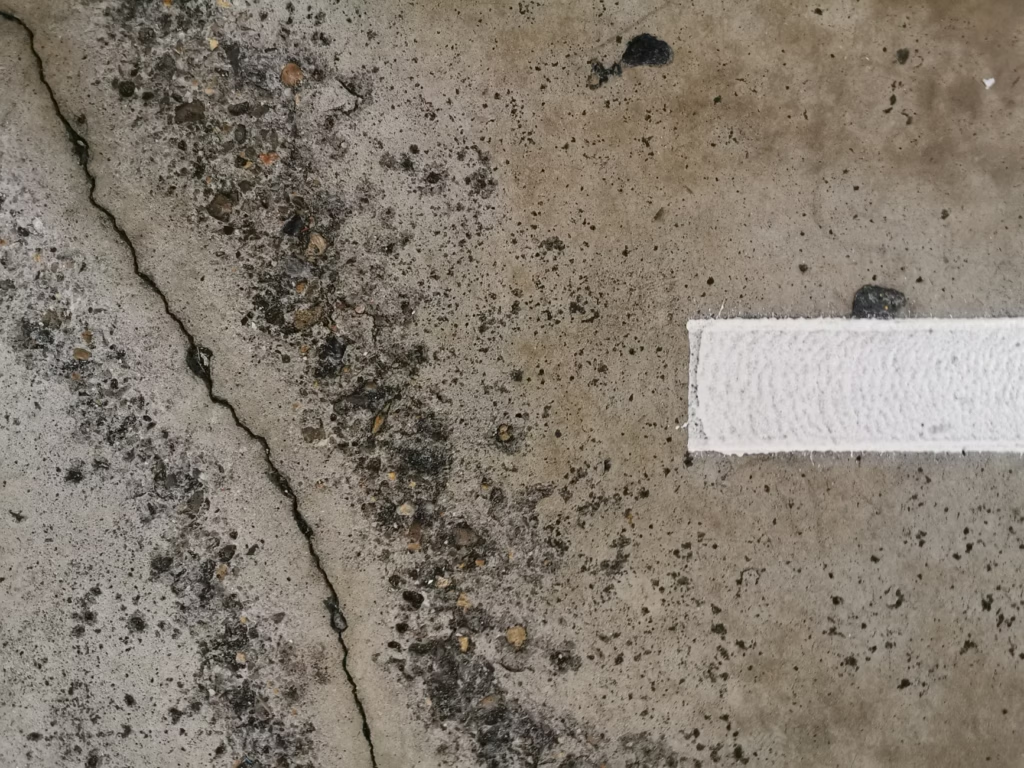
You see it in October. The sun is lower, the nights cool off fast, and that hairline crack that barely showed in July suddenly looks wider after a cold morning. Around here the sprinkler shutoff season is also the season where water ends up where you do not want it, down the edge of the slab, into a control joint, or sitting in a low spot by the garage. Then we get that first hard freeze and the driveway starts talking back. Sometimes it is just a little pop and nothing changes. Sometimes the crack starts to ravel at the edges, or you get a tiny ridge where one side lifts a touch higher than the other.
Winter can make cracks act worse, not because concrete “decides” to fail, but because water, temperature swings, and traffic all work the same weak points. The good news is you can plan repairs that survive cold nights, and you can do a few prep steps now that keep small cracks from turning into spalls by spring.
What freeze and thaw actually do to a cracked slab
Concrete does not need a deep Minnesota winter to get damaged. A handful of freeze thaw cycles is enough if there is water in the crack and the concrete at the edge is already a little weak. Water expands about 9% when it freezes. In a tight crack, that expansion acts like a jack. It can widen the crack slightly, but more often we see the edges start to chip (spalling) or turn sandy (raveling), especially if the surface paste was finished too wet or the slab was not cured well.
Another winter issue is movement. Concrete shrinks as it cures, then it expands and contracts with temperature. A 30°F night followed by a 60°F afternoon is a real swing, and it makes the slab move. If the crack is through the full depth, the two sides can rub under tires and start breaking down the corners.
If you see a crack that is wider than 1/8 inch, has missing chunks along the edge, or is holding water after a rain, that is the kind that tends to change over winter.
De icing salts and “helpful” chemicals that chew up crack edges
Most Albuquerque homeowners are not dumping rock salt like they do back east, but we still see damage from de icing products on driveways. Magnesium chloride and calcium chloride work at lower temperatures than plain sodium chloride, and they also pull moisture. That wet, salty film sits right where the crack edges are already exposed.
On concrete, salts can do two things. First, they keep the surface wet longer, which means more chances for freezing in the pores. Second, they can contribute to surface scaling when the top layer is weak. Scaling looks like thin flakes coming off, usually starting along cracks, joints, and the tire paths. If you are dealing with flaking already, this ties in with why Albuquerque driveways start flaking and what we do to stop it.
If you need traction, sand is the safest short term option for concrete. If you do use a de icer, keep it light and keep it off the slab once the sun hits. Sweep it away. Do not let it sit for weeks.
Also watch the products you use around the garage. Fertilizer overspray, pool salt, and some wheel cleaners end up on the driveway. In winter they do more harm because they keep the surface damp.
Irrigation shutoff season, drainage, and why water shows up where you did not expect
Fall is when we see a lot of surprise water. A line gets blown out and a fitting seeps for a week. A hose bib drips overnight. A downspout extension gets kicked loose. That water runs to the lowest point, which is often the driveway edge or the joint at the garage apron.
Concrete hates standing water in winter. If water sits along one side of the slab and the other side stays dry, the slab sees uneven moisture and temperature. That is a recipe for curling at the edges. Curling is when the slab corners lift slightly because the top and bottom are shrinking differently. You notice it as a little rock under your tire, or a gap you can slide a putty knife into at the corner.
Walk the driveway after a rain. Look for spots that stay dark and wet 24 hours later. Check the slope. A driveway should shed water, not funnel it to the foundation.
If the crack is in a low spot, repair alone will not last unless we also address the drainage that keeps feeding it. A lot of the worst ponding and cracking starts right at the apron, and this is the same problem we cover in why Albuquerque driveways sink at the garage and what fixes it.
Which cracks get worse over winter, and which ones usually just sit there
Not every crack is an emergency. Concrete driveways crack. Some of them stay tight for years.
Here is what we look at on a Concrete Driveway Repair Evergreen call.
Cracks that tend to change in winter
- Cracks that hold water after a rain or snow melt. Water plus freezing is the driver.
- Cracks with edge damage (spalls, missing corners). Once the edge is gone, tires finish the job.
- Cracks with vertical offset (one side higher). Even 1/4 inch of differential movement can start chipping.
- Cracks that run to the slab edge and let water in under the concrete.
Cracks that often stay stable
- Tight hairlines you cannot catch with a fingernail.
- Shrinkage cracks that are narrow, clean, and not moving under load.
We do not guess from a photo. We check width, depth, and movement, and we look for subgrade issues like soft spots or voids near the edge. If the slab is rocking, patching the top is not the fix.
Repair timing: what we can do now, and what we schedule once nights stay cold
October is a workable window for a lot of repairs because concrete and repair materials still cure properly during the day. Once nighttime lows start living near freezing, timing gets touchy. If you are planning a full replacement instead of patch work, best time of year to pour a concrete driveway in Albuquerque lays out what we watch for.
For crack repair, surface temperature matters more than air temperature. Many repair epoxies and polyureas want the concrete at 50°F and rising for best bond. Below that, cure slows down and you can trap moisture. That is how you get a repair that looks fine for a month, then pops loose.
If a crack is actively getting worse, we would rather clean it, prep it, and repair it before the hard freezes stack up. Prep is the part homeowners do not see, and it is most of the job. We route or open the crack as needed, blow it out with oil free compressed air, and keep the edges clean. If there is any sign of moisture, we plan the product around it.
When it is too cold for certain materials, we can still do evaluation, drainage corrections, and plan for a spring repair that does not fail the first winter after it is done.
Materials that survive winter: why the right filler matters more than the label
There is a big difference between “sealed” and “repaired.” A thin bead of caulk over a dirty crack does not stop water from getting in, and it does not handle movement.
For a driveway, we match the material to what the crack is doing.
- Concrete crack sealant (polyurethane) is flexible. It handles expansion and contraction better than rigid products. It needs a clean, dry bond line, and in wider cracks we use backer rod (closed cell foam) so the sealant is not too thick.
- Epoxy is strong and rigid. It can be right for tight cracks that are not moving, especially where we are trying to restore load transfer. If the slab is moving, epoxy can crack again right next to the repair.
- Polyurea sets fast and stays flexible. It is good for certain crack profiles, but surface prep has to be on point.
On spalled edges, we often step up to a polymer modified repair mortar designed for thin sections. The key detail is making sure the patch has enough thickness to hold. A feather edge, meaning near zero thickness, breaks off.
Replacement versus repair: the winter signs that tell us the slab is past patching
Some driveways can be repaired for a long time. Some are telling you they need replacement, and winter tends to make the evidence obvious.
If you have multiple areas with vertical displacement, that points to subgrade movement, poor compaction, or water getting under the slab. If you have repeated spalling in the tire paths, that can be a finishing and durability issue in the top layer. If the slab has random low spots that pond water, the drainage is wrong, and freezing makes those spots break down faster.
We also look at thickness and reinforcement. A driveway that was poured too thin at the edges, or one that has no steel where it needs it, is more likely to crack and move. Typical residential driveways are often around 4 inches thick, but thickness alone is not the whole story. The base matters. A well compacted base and proper jointing keep movement under control. If you want the nuts and bolts on steel and slab section, read do Albuquerque driveways need rebar and a thicker slab.
For Concrete Driveway Replacement, we do not just swap concrete. We correct grade, build a base that drains, and place joints so the slab has a plan for where it will crack. If you are trying to get a new slab through its first cold season without surface damage, protecting your new concrete driveway, expert tips for winter and beyond is worth a read.
We see this a lot in Albuquerque, NM where sun, dry spells, and sudden cold snaps all show up in the same season.
Key Takeaways
- Water sitting in a crack is what makes winter damage accelerate, it drives spalling and raveling at the edges.
- De icers like magnesium chloride and calcium chloride keep concrete wet longer, that raises the risk of scaling around cracks.
- Cracks wider than 1/8 inch, cracks with missing edges, and cracks with 1/4 inch offset tend to change over winter.
- Many crack repair products bond best with concrete at about 50°F and rising, cold slabs lead to slow cure and poor adhesion.
- Flexible polyurethane sealants with backer rod handle seasonal movement better than rigid fills in moving cracks.
Conclusion
Winter can make driveway cracks look worse fast, but the real problem is usually simple: water getting into places it should not be, then freezing, then traffic grinding on the weak edges. If you catch it in the fall, you have more options that last. If you wait until the cold sets in, the job turns into scheduling around temperatures and moisture, and some repairs need to wait until conditions are right.
If you are seeing edge chipping, standing water, or any spot where one side of a crack sits higher than the other, let us take a look. We will tell you straight if it is a repair that will hold through winter, or if the slab needs a bigger fix so you are not chasing the same damage every spring in Albuquerque, NM.